The Blazing-World
The Blazing WorldThe Blazing-World is a separate, richly inhabited world reached through the meeting of the poles of two worlds. The young lady arrives there by accident after a storm drives the boat in which she has been abducted through the Icy Sea; she is taken from island to island and eventually to Paradise, where she becomes Empress. The world’s unusual geography, diverse peoples, and centralized government give the novel its setting for both speculative natural description and an argument about political unity. Its order is later put to work beyond its borders, when the Empress leads its forces to aid her native country and compels other nations to submit to the King of Esfi.
Geography and passage
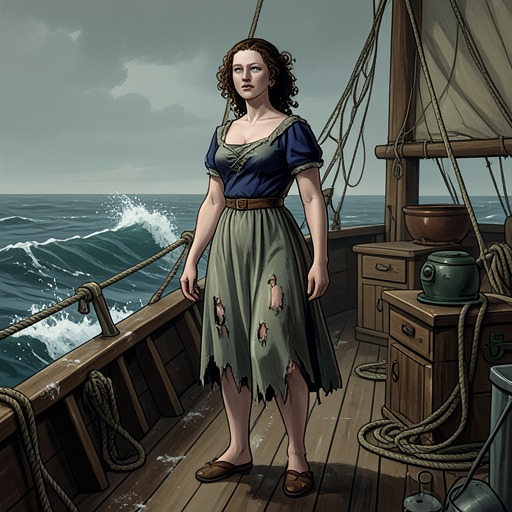
The Blazing-World is not reached by sailing around the familiar world. At the poles, the poles of adjoining worlds meet, preventing a traveller from completing a circuit in that direction; someone arriving there must either turn back or pass into another world. The storm-tossed boat carries the young lady across that threshold into the Icy Sea. The men aboard freeze, while she survives and is eventually found by upright, bear-shaped inhabitants who take her ashore and sink the boat with the dead men still aboard.
Her route inland is a sequence of crossings and welcomes. The Bear-men take her to a warmer island inhabited by Fox-men; their party travels onward with Bird-men, then through the territory of the Satyrs and into a kingdom whose inhabitants are grass-green. At first the travellers cross rivers in boats; beyond that kingdom they must sail the open sea toward the Emperor’s residence. As the young lady learns enough of the inhabitants’ language to understand them, her fear of the unfamiliar gives way to a sense of safety. The journey thus links the world’s geography to an account of encounter: passage depends on hospitality, shared speech, and successive communities escorting her onward.
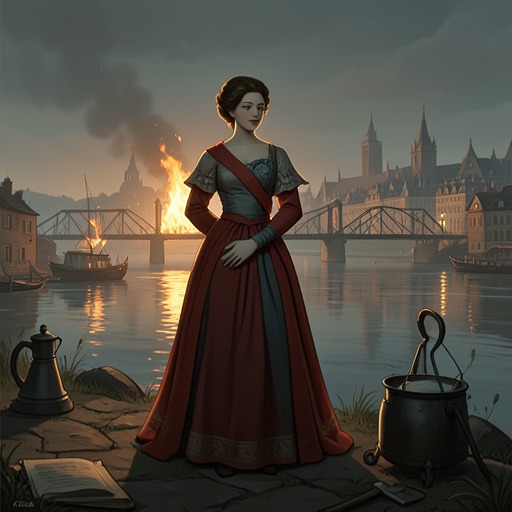
The imperial region is itself a network of large rivers that divide the land into islands of unequal distance from one another. It is fertile, healthful, and mild in climate. Its seaward approach is naturally defensible: there is only one entrance, a winding labyrinth among rocks that admits small boats carrying no more than three passengers at a time. Cities line the narrow river route, built of materials including marble, alabaster, agate, amber, and coral. Paradise, the imperial city, is arranged like a group of islands, with rivers between its streets and numerous bridges; its buildings are made of gold. The setting’s splendour is paired with restricted access, so the same waterways that make the city distinctive also help shelter the imperial center from invasion.
Peoples, government, and material life
The world’s inhabitants vary greatly in form and complexion. The account names Bear-men, Fox-men, Bird-men, Satyrs, Fish-men, Worm-men, Fly-men, Ape-men, and many others. Rather than treating those differences only as curiosities, the Empress assigns groups work associated with their supposed aptitudes: Bear-men serve as Experimental Philosophers, Bird-men as astronomers, Fly-men, Worm-men, and Fish-men as Natural Philosophers, and Ape-men as chymists. Other groups become physicians, politicians, mathematicians, orators, logicians, and architects. The Empress encourages their studies, establishes schools, and founds learned societies. This division of intellectual labour gives the world an organized social structure, though it is presented through classifications imposed by the Empress and the narrator, not through an account of the peoples defining their own identities.
Political authority is concentrated in one Emperor, to whom all the world submits. The States-men defend a small number of laws on the grounds that too many laws create divisions and factions, which can develop into war. They likewise prefer monarchy to government by many rulers: they compare a political body with several governors to a many-headed monster, and align one Emperor with their worship of one God. Their explanation makes the relationship between religious and political unity explicit. The narrator presents this arrangement as the basis of the world’s continuing peace, without foreign wars or domestic insurrections.
The imperial capital makes hierarchy visible in material form. The Emperor’s ships are gold, while merchants’ and skippers’ vessels are leather; trade operates by exchanging goods rather than using coin. Gold and jewels are abundant, but their use is restricted: gold belongs to the imperial family, and only the Emperor, Empress, and eldest son may wear jewels. Priests and Governors are drawn from imperial princes and made eunuchs for those offices. These rules distribute wealth and public authority through the imperial household rather than allowing abundance to become universal possession.
The Empress and the imperial center
On arrival at court, the young lady is mistaken for a goddess. She refuses the Emperor’s offer of worship and explains that, although she comes from another world, she is mortal. Rejoicing at this answer, he marries her and gives her absolute power to rule as she pleases. Her subjects continue to venerate her as if she were divine. The episode establishes the Empress’s rule through both imperial grant and popular awe, while her refusal of divine status distinguishes her own account of herself from the public image formed around her.
Her regalia turns the world’s precious materials into emblems of sovereignty. She wears a pearl cap and a diamond half-moon, crowned by a broad carbuncle cut like the sun; her clothes and footwear are made from pearls and coloured diamonds. A rainbow-like diamond buckler in her left hand signifies the defence of her dominions, while a white-diamond spear in her right signifies readiness against enemies. Later, when she appears over the water to direct the defence of her native country, she again wears imperial jewels and carries a buckler and spear. The repeated display makes the Empress’s authority legible across worlds: she arrives not merely as a traveller returning home, but as the ruler of a powerful state.
The world’s military and practical inventions further distinguish its capacity from that of the young lady’s original world. Its navigators can identify depths, sandbanks, and rocks without compasses, charts, or watches, relying instead on observation and experience. Ships can be joined closely together, and an air-drawing engine can force wind against waves to open a passage through a storm. The Emperor’s gold ships are carefully made and do not require the heavy equipment used on wooden vessels in the familiar world. Later, the Empress’s expedition also depends on specialized labour: Fish-men travel under water and Bird-men through the air, while the ships are adapted to be drawn beneath the sea and to supply breathable air to land animals aboard.
War beyond the world and the return
After her government has been settled, the Empress learns from the Immaterial Spirits that her native country is threatened by a coalition of nations. She is distressed, and the Emperor agrees to let her return with assistance. Her expedition brings together different groups of her subjects and requires many ships and provisions; she also refuses to exhaust the Bird-men with uninterrupted flights, arranging for them to rest. When Bear-men discover the enemy fleet, she sends Bird-men and Fish-men to reconnoitre. At night, the forces display thousands of Fire-stones, creating the appearance of flames across sea and air and frightening the enemy. The next day, Fish-men carry the stones in diamond cases to the enemy ships, uncover and wet them beside the hulls, and set the fleet ablaze; the powder aboard then explodes. The destruction of the invading fleet saves the Empress’s native country from its immediate naval danger.
The campaign does not end with rescue. The King of Esfi asks for help because enemy forces still obstruct his dominions’ trade. The Empress promises to burn or sink ships that refuse tribute and uses Fire-stones against resisting settlements as well as fleets. In one country that receives little rain, her forces place the stones at the supports beneath houses; when the annual tide comes in, the houses catch fire, and the resulting devastation and barrenness force submission. The other nations also yield after seeing the effects of her power. The Empress thereby makes the King of Esfi the absolute monarch of the world, extending her intervention from defence of her native country into an imperial tributary order.
She subsequently receives the princes of the subjugated nations in a meeting at sea. They gather their ships in a circle, and the Empress appears in jeweled robes; during a night entertainment, Fire-stones illuminate air and sea before the Bird-men carry her aloft. At daybreak she declares that the King of Esfi has become head-monarch and urges the princes to pay tribute so that they may live peaceably. After they withdraw, her own fleet enters the circle and then sinks beneath the sea, remaining underwater until it reaches the Blazing-World. The spectacle makes the terms of the new order unmistakable: peace is offered, but under a sovereignty secured by overwhelming force.
Peace, imagination, and political tension
The Empress returns to the Blazing-World and is welcomed by the Emperor, who loves her deeply; she returns his affection. Yet the world’s peaceful unity is not the same as a universal ideal of peace. The Empress’s campaign has destroyed enemy fleets and compelled nations to accept the King of Esfi’s supremacy. The contrast is sharpened in the closing account of world-making: the author says that the Blazing-World allows one religion, one language, and one government, while acknowledging that another imagined world could instead be full of factions, divisions, and wars. The world is therefore both a refuge from political fragmentation and a creation whose order rests on concentrated power.
The final framing presents the Blazing-World as part of the author’s own imaginative domain. Its materials, like those of a second philosophical world, are described as the rational parts of the author’s mind. The author takes greater delight in creating worlds than the conquering monarchs Alexander and Caesar did in territorial conquest, and claims to have caused fewer deaths than their wars. The Blazing-World’s fictional Empress is identified as the author’s Platonic friend, whose throne the author refuses to usurp; dissatisfied readers, meanwhile, may create worlds of their own in their minds and imaginations. The location thus becomes more than a distant country in the tale: it is also a made world whose political order and sovereignty the author can shape, while preserving the Empress’s rule within it.